
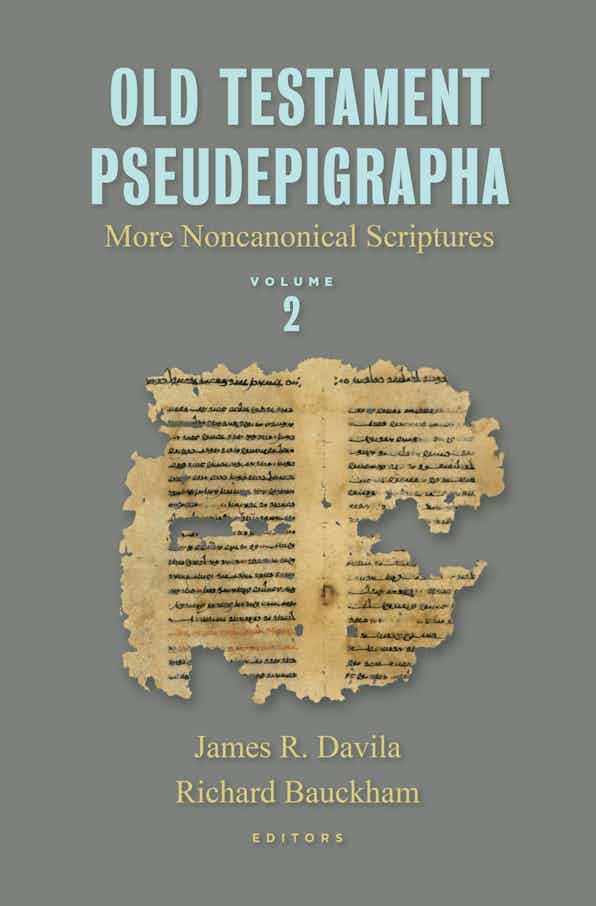
Information about a new publication in apocrypha studies has appeared on the Eerdmans website, featuring the forthcoming Old Testament Pseudepigrapha: More Noncanonical Scriptures, vol. 2, edited by James R. Davila and Richard Bauckham. The table of contents on the website reveals some exciting new translations of pseudepigrapha from experts in the field.
Here I want to provide a preview of my contribution, about the Fifteen Signs before Judgment. I’ve worked on this particular apocryphon (or pseudepigraphon, if you prefer that term) off and on for about the last fifteen years. It’s a fascinating work, with many different iterations and challenges, and it continues to capture my attention when I turn to work on it.
Below are some excerpts from my contribution to the second volume of Old Testament Pseudepigrapha: More Noncanonical Scriptures (MOTP2), to give readers a sense of what to look for in the collection.
The Fifteen Signs before Judgment lists the portents on the fifteen days leading up to the eschaton. Composed in the early medieval period, this eschatological work is similar to earlier lists of events leading up to judgment day. The textual tradition of the Fifteen Signs is highly variable, and multiple versions circulated during the Middle Ages. Lists are extant in Latin, Hebrew, and Armenian, as well as most Western European languages. Versions of the Fifteen Signs were also embedded in many later Latin and vernacular pieces of literature.
The most important witnesses of the Fifteen Signs tradition survive in Latin, Hebrew, and Armenian, from which were translated various other versions. The Latin versions are earliest, although there are no compelling criteria available that enable us to discern the language of composition. Considering the wealth of evidence in Latin and Western European languages, the most plausible explanation is that the Fifteen Signs was composed in Latin and later adapted into other versions as well as translated into other languages, including Hebrew, Armenian (which is a translation, but the source language is uncertain), Slavic, and many other European vernaculars.
There is, however, still room for doubt, and precise relationships between Western and Eastern versions remain uncertain. I wrote about some of these complicated relationships in my article “Biblical Apocrypha as Medieval World Literature” (The Medieval Globe 6, no. 2 (2020): 49–83). The contribution to MOTP2 includes much more bibliography, including editions and translations as well as scholarship on the various versions of the Fifteen Signs.
Below is translation of what is probably the earliest surviving form of the Fifteen Signs, a Latin version found in a collection called the Collectanea Pseudo-Bedae. It gives a sense for the text and some of its quirks. I’ve included some of the biblical parallels noted in my new translation.
Jerome found in the annals of the Hebrews the fifteen signs of the fifteen days before the day of judgment.
On the first day, the sea will rise to the height of forty cubits above the height of mountains and will be like a wall (Exod 14:22, 29) and the rivers likewise. (Gen 7:20)
On the second day, they will descend to the deep, so that one can barely see their height.
On the third day, they will be level, just as they were at the beginning.
On the fourth day, the fish and all the beasts of the sea will be gathered above the waters and will give cries and groans, (Jub. 23:18) whose meaning is known to none except God.
On the fifth day, the waters themselves will burn from the rising to the setting (of the sun).
On the sixth day, all the grass and trees will give a bloody dew. (4 Ezra 5:5)
On the seventh day, all buildings will be destroyed.
On the eighth day, the rocks will fight each other, and each will divide itself into three parts, and each part will strike against another.
On the ninth day, there will be an earthquake, like there has not been since the beginning of the world. (Ezek 38:20; 4 Ezra 9:3)
On the tenth day, all the hills and valleys will be turned back into a plain, and the earth will be level. (Isa 40:4)
On the eleventh day, men will emerge from their caves, and they will run around as if insane, and each one will not be able to answer the others.
On the twelfth, day, stars and tokens will fall from the sky. (Isa 34:4; Matt 24:29; Rev 6:3; 8:10; 4 Ezra 5:5)
On the thirteenth day, the bones of the dead will be collected, and they rise as far as the grave. (Ezek 37:12; Matt 27:52)
On the fourteenth day, all men will die, so that they might rise together with the dead.
On the fifteenth day, the earth will burn as far as the edge of hell, and afterward will be the day of judgment.
Besides this Latin version, my contribution to MOTP2 includes translations of two other major Latin versions (Damian, and Comestor types) in parallel, a Hebrew version, and three Armenian recensions in parallel.
 Brandon W. Hawk